Your Body Is the Tool: Why Workplace Ergonomics Keeps You Working
Every working day, your body absorbs the demands of your job. You lift, grip, reach, twist, carry, and repeat. Nobody stops to ask whether the task was designed for a human body or designed for speed. That gap is where workplace ergonomics matters most, and where ergonomic injuries begin
In 2024/25, 511,000 workers in Great Britain suffered a work-related musculoskeletal disorder, costing the economy £22.9 billion and 7.1 million lost working days.
What Workplace Ergonomics Actually Means
Ergonomics is the science of designing work, tools, tasks, and environments to match the capabilities of the worker. The core principle is fitting the job to the person rather than the person to the job. That principle applies on a construction site, on a production line, in a baggage handling bay, in a warehouse, and at a computer workstation. Every industry where people perform physical or repetitive tasks carries workplace ergonomic risk.
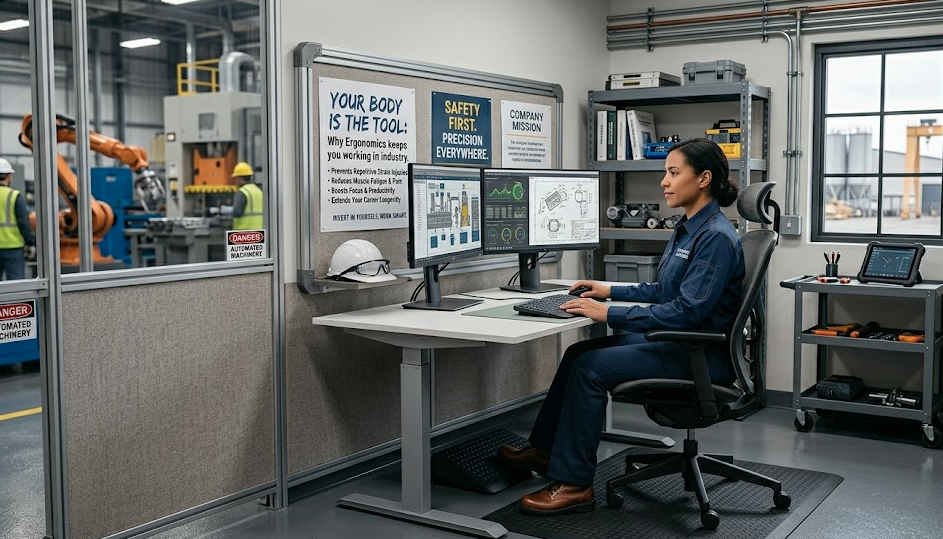
Upper Limb Disorders: A Key Risk in Workplace Ergonomics
Upper limb disorders are conditions affecting the muscles, tendons, ligaments, nerves, and joints of the fingers, hands, wrists, arms, shoulders, and neck. Around 506,000 people in Great Britain are currently affected, leading to approximately 4.2 million lost working days per year.
These conditions go by several names. Repetitive strain injury. Cumulative trauma disorder. Occupational overuse syndrome. The name matters less than understanding what causes them. ULDs do not usually arrive suddenly. They develop across weeks, months, and years of accumulated strain, often with early warning signs that workers learn to push through. That habit of pushing through is where temporary soreness becomes permanent injury.
The Six Risk Factors You Need to Know
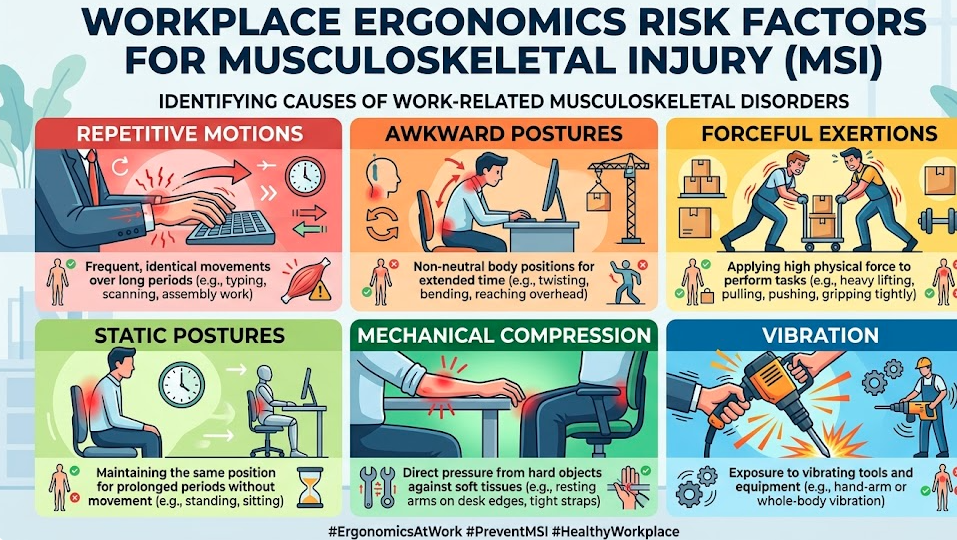
Every supervisor, safety officer, and frontline worker should know these six primary risk factors for musculoskeletal injury.
Repetition
The same muscles used in the same pattern without adequate recovery lead to fatigue, tissue inflammation, and injury. For example, food manufacturing, logistics scanning, and assembly tasks all carry high-repetition risk.
Force
The load placed on muscles, tendons, and joints during lifting, gripping, pushing, or pulling. Poor posture also increases the force required for any given task. Vibrating tools increase grip force without the worker realising it.
Awkward Posture
Any position that moves the body away from its neutral alignment. Bent wrists, overhead reaching, or twisted trunk positions all increase muscle effort and injury risk. The further from neutral, the greater the risk.
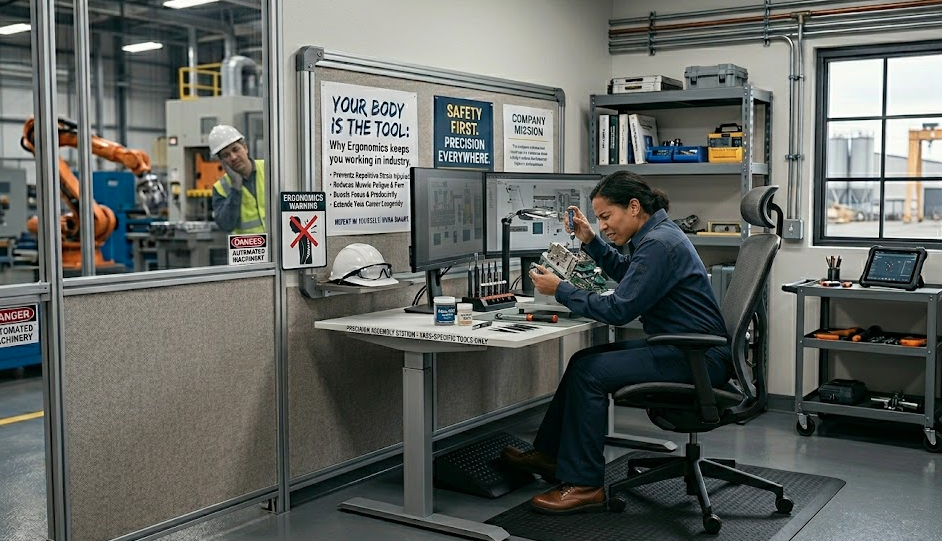
Static Posture
Holding a fixed position for extended periods reduces blood flow, accelerates muscle fatigue, and limits recovery. As a result, standing at a fixed workstation without postural variation is a high-risk pattern most workplaces overlook.
Vibration
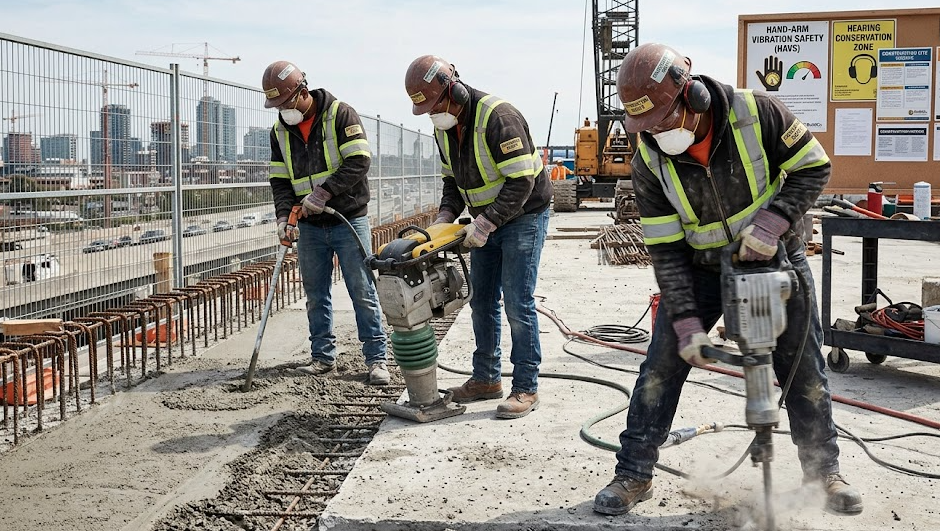
Hand-held power tools, machinery, and vehicles all contribute to upper limb disorders and conditions such as vibration white finger and carpal tunnel syndrome.
Duration
How long a worker is exposed to any combination of the above risk factors in a single shift and across multiple working days. So longer exposure with less recovery time produces cumulative strain that builds invisibly until it becomes an injury.
Your Legal Duties on Workplace Ergonomics
UK law places clear obligations on employers to manage workplace ergonomic risks. These are not guidance notes. They are enforceable duties.
The Health and Safety at Work etc. The 1974 Act imposes a general duty on employers to ensure the health, safety, and welfare of all employees. The Management of Health and Safety at Work Regulations 1999 require suitable and sufficient risk assessment for all workplace hazards, including ergonomic ones. The Manual Handling Operations Regulations 1992 require employers to avoid hazardous manual handling where reasonably practicable, assess the risk where it cannot be eliminated, and reduce that risk to the lowest level reasonably practicable.
Civil law also applies. A single successful injury claim from a worker who developed a preventable upper limb disorder will cost significantly more than a properly managed prevention programme.
What Good Workplace Ergonomics Prevention Looks Like
Effective workplace ergonomic controls address the root cause of risk, not just the worker’s behaviour. Training alone does not prevent musculoskeletal injury. The work itself has to change.
In food manufacturing, it means adjustable conveyor heights, job rotation on repetitive cutting or packing tasks, and cold-environment controls. For warehousing and logistics, it means lift-assist devices and repositioning stock so workers do not lift from floor level. Moreover, for construction work, it means selecting ergonomic power tools with anti-vibration ratings and rotating workers off high-vibration tasks. Within the office environments, it means a monitor at eye level, keyboard within neutral reach distance, and workstation assessments before symptoms appear rather than after.
The Cost of Waiting
One reported symptom often means many more workers are experiencing the same problem but not yet speaking up. Every week of delay between symptom onset and task review increases the probability that temporary discomfort becomes a chronic condition.
Employers who create a reporting culture where workers feel safe to raise concerns early prevent far more injuries than those who rely on accident records and sick leave data to tell them what is wrong. By the time the data shows a problem, the injury has already happened.
Your body is the tool. It carries you through every shift, every lift, every task. Workplace ergonomics exists to make sure the work you do does not wear that tool down faster than it should.
Download the free ToolboxReady resource pack for practical safety templates you can use on shift today.

One Comment