Why Toolbox Talks Fail and What to Do Instead
Most sites run toolbox talks. Most workers sit through them. Understanding why toolbox talks fail starts with looking at what happens after the session ends. The toolbox talk was delivered. Someone signed the sheet. The supervisor covered the hazard. Then a worker got injured by the exact hazard covered two weeks earlier.
The question is not whether toolbox talk tips apply in theory. The question is why they so consistently break down in practice.
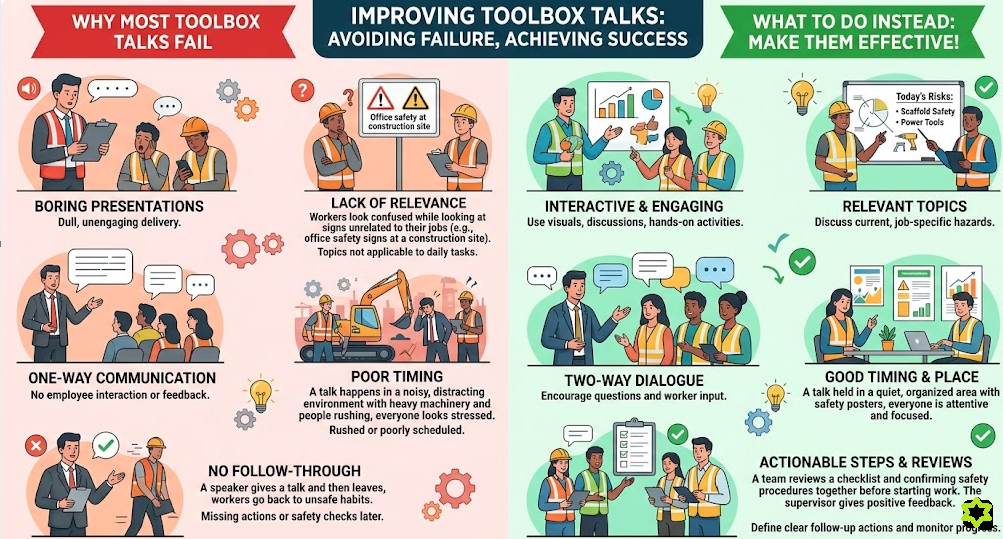
The format is designed for the presenter, not the audience
A standard toolbox talk is a sheet of text that a supervisor reads aloud to a group of workers. They stand outside, often at the start of a shift, when their minds are already on the task ahead. The supervisor reads. The workers listen. Someone collects signatures. Everyone moves on.
That format serves one purpose. It creates a record. It does not create understanding. Workers need to talk, not just listen. They need to identify the hazard themselves, not receive it as a statement. They need to connect the content to their specific task that day, not a generic industry scenario. Change the format, and the engagement follows.
Why toolbox talk fails – the content is generic, and workers know it
Most toolbox talk templates are written for broad compliance. They cover a hazard category at the surface level and end with a list of control measures. Workers who have been on site for more than a year have heard the same content multiple times in slightly different words.
Make the content specific. If you are briefing on forklift safety, talk about the blind spot at the end of aisle seven, not blind spots in general. Specificity is what makes content stick.
Why Nobody Asks Questions at the End
The end of most toolbox talks sounds like this. Any questions? Silence. Sign the sheet. That silence is not understanding. It is a combination of social pressure, time pressure, and the learned behaviour of workers who have asked questions before and felt the conversation move on too quickly.
Build questions into the talk, not at the end of it. Ask workers to identify the hazard before you tell them what it is. What they would do if the control measure were not available. Review with them what they saw on site yesterday that concerned them. Make the conversation the point, not the signature.
Why the Timing Works Against You
Toolbox talks delivered at the start of a shift compete with every other thing a worker is thinking about. The task ahead. The colleague they need to coordinate with. The equipment they need to check. Consider shorter, more frequent safety conversations at the point of work rather than one weekly briefing in the car park. A two-minute conversation at the workface before a high-risk task begins is more effective than a fifteen-minute session delivered to twenty people at 6 am.
What a good toolbox talk actually looks like.
It is short. Five to eight minutes maximum. Ensure it covers one hazard, not five and uses a real example from the site or industry, not a generic scenario. Ask workers to speak, not just listen. It ends with one clear action, not a list of bullet points. The signed sheet is still important for compliance. But the conversation is what keeps people safe.
If your toolbox talks are feeling like a routine that nobody takes seriously, the problem is not your workers. It is the format. Change the format, and the engagement follows.
Download the free ToolboxReady Toolbox Talk Template Pack. Five ready-to-use templates built for real workplaces. Practical, specific, and free.
Summary of Topic